On this page
The Securities and Exchange Commission of Pakistan (SECP) has issued Circular No. 26 of 2026, dated 16 November 2026 and announced on 18 November. It amends Circular No. 12 of 2024 of 15 May 2024, which sets the requirements for non-banking finance companies (NBFCs) engaged in digital lending, and sharply lowers the maximum cost of digital nano-loans. SECP says the aim is to protect borrowers from a high cost of credit and from falling into a cycle of costly repeat borrowing. The circular is issued under section 282B(3) of the Companies Ordinance, 1984, read with regulation 28(da) of the Non-Banking Finance Companies and Notified Entities Regulations, 2008.
The new limits
| Point | New borrower | Repeat borrower |
|---|---|---|
| Maximum APR (previously 274%) | 90% a year | 70% a year |
| Maximum profit rate per day, about | 0.2466% | 0.1918% |
| On a Rs 10,000 loan, per day, about | Rs 24.66 | Rs 19.18 |
| Maximum nano-loan from one lender | Rs 50,000, for up to 90 days | |
| Maximum total tenor, including all rollovers | 90 days | |
| Maximum nano-lending to one borrower by all NBFCs together | Rs 100,000 at any time | |
The cap covers the total cost of credit: all mark-up and every fee or charge, by whatever name, that the borrower pays in connection with the loan, including processing, service, platform, verification, handling, notarial, early repayment, rollover, extension and membership charges. The lower 70% cap must be applied to a repeat borrower automatically, without any request. A repeat borrower is one who has already obtained and fully repaid their latest loan from the same lender within its original maturity. SECP notes that at the former 274% ceiling, a Rs 10,000 loan for 14 days would have cost about Rs 1,051.
How to check a loan against the cap
The circular sets the formulas. The profit rate per day is the total cost of credit divided by the principal, times 100, divided by the number of days of the loan. The APR is that daily rate times 365, with no compounding. SECP's own examples use a Rs 10,000 loan for 14 days:
- New borrower: the most the lender can charge in total is Rs 345.21. Mark-up of Rs 200 plus fees of Rs 100 gives a total cost of Rs 300, an APR of 78.21%, which is within the cap.
- Repeat borrower: the most the lender can charge is Rs 268.49. A total cost of Rs 250 gives an APR of 65.18%, within the cap; Rs 350 would not be allowed.
- Rollover: if the same new-borrower loan is rolled over for another 14 days, the cap applies to all 28 days together, so the total cost, including any rollover fee, cannot exceed Rs 690.41.
Rules for every nano-loan
- No compounding: no mark-up may accrue on mark-up or on late payment charges.
- Early settlement must be allowed, with the profit rate charged only for the days the loan was outstanding.
- No automatic rollovers. A loan may be rolled over, extended or restructured only at the borrower's express request, after the borrower has been shown a fresh Key Fact Statement giving the cost in rupees and as an APR. The cost for the rollover period must stay within the cap that applies to the borrower on the date of rollover.
- Total cost cap: the lender may not recover more than the principal on account of all costs of the loan, including penalties for late payment and non-payment. In other words, the total repaid can never exceed twice the principal.
- Simple structure: the whole principal must be disbursed on the issue date, and principal and profit repaid in a lump sum at maturity, earlier on early settlement, or in equal instalments.
- No workarounds: a lender may not, directly or through an associate, agent or partner, split one loan into two or more, make the borrower buy another product or service, or make any other arrangement that results in a charge above the cap. Any such amount counts in the total cost of credit.
- One loan at a time: no new nano-loan to a borrower while an earlier loan from the same lender is outstanding.
- Late payment: no late charge for three days after the maturity date. After that, late charges apply only to the overdue principal, at no more than the applicable daily profit rate.
- Refunds: any amount charged above the limits must be refunded or adjusted within seven working days of the lender becoming aware of it, or of the borrower or SECP pointing it out, and the borrower told by SMS and in-app message.
Changes to apps, products and reporting
- Whenever a user opens the nano-lending app or website, a risk warning in English and Urdu must appear, explaining that digital nano-loans are short-term loans with high interest and extra charges, and urging users to borrow responsibly.
- A cost calculator must be on the app or website home page, showing the effect of the processing fee, platform fee, profit rate, late payment charges and other charges for different borrowing options.
- Any change to a whitelisted app needs prior intimation to SECP, treated as acknowledged if SECP raises no query within seven working days. A new financing product, meaning one with a different transaction flow, pricing or repayment mechanism, or a separate financing proposition or user journey, needs SECP's prior acknowledgement.
- The monthly loan portfolio report (Annexure B) has a new format, with figures split by male and female borrowers and the minimum, maximum and average APR charged, rollovers, late payment fees and refunds.
Existing loans and deadlines
| What | When |
|---|---|
| Loans disbursed before the circular | May run on their agreed terms until their original maturity, but any rollover or restructuring from the circular's issue must follow the new rules |
| Borrowers who had fully repaid their latest loan on time before the circular | Treated as repeat borrowers |
| Update the app, website, Key Fact Statement, loan agreement, cost calculator and risk warning to show the new caps (the warning must state the maximum APR in English and Urdu) | Within 15 days of issue |
| Tell every borrower with an outstanding loan, by SMS and in-app notice in English and Urdu, about the new caps and that any rollover will be charged at the new rate | Within 15 days of issue |
| Send SECP a certificate signed by the Chief Executive Officer and the Compliance Officer confirming that all loan products comply | Within 30 days of issue |
The circular is dated 16 November 2026, so counting from that date the 15-day steps fall due by 1 December 2026 and the certificate by 16 December 2026.
What lenders should do now
- Reprice every nano-loan product so that the all-in APR stays within 90%, or 70% for repeat borrowers, using SECP's formula
- Flag repeat borrowers in the loan system so the 70% cap applies automatically
- Enforce the Rs 50,000 and 90-day limits, including rollovers, and block a new loan while one is outstanding
- Switch off compounding and automatic rollovers, and build a rollover request step with a fresh Key Fact Statement
- Set late charges to start after three days, on overdue principal only, and cap total costs at the principal
- Add the English and Urdu risk warning and the home-page cost calculator
- Update the app, website, Key Fact Statement and loan agreement, and notify existing borrowers, by 1 December 2026
- Review past charges for amounts above the caps and refund them within seven working days
- Send the CEO and Compliance Officer certificate to SECP by 16 December 2026, and switch to the new monthly report format
Official sources
- SECP — Circular No. 26 of 2026: Amendments to Circular No. 12 of 2024, Requirements for NBFCs engaged in digital lending, 16 November 2026 (listed on SECP's website under 17 November 2026)
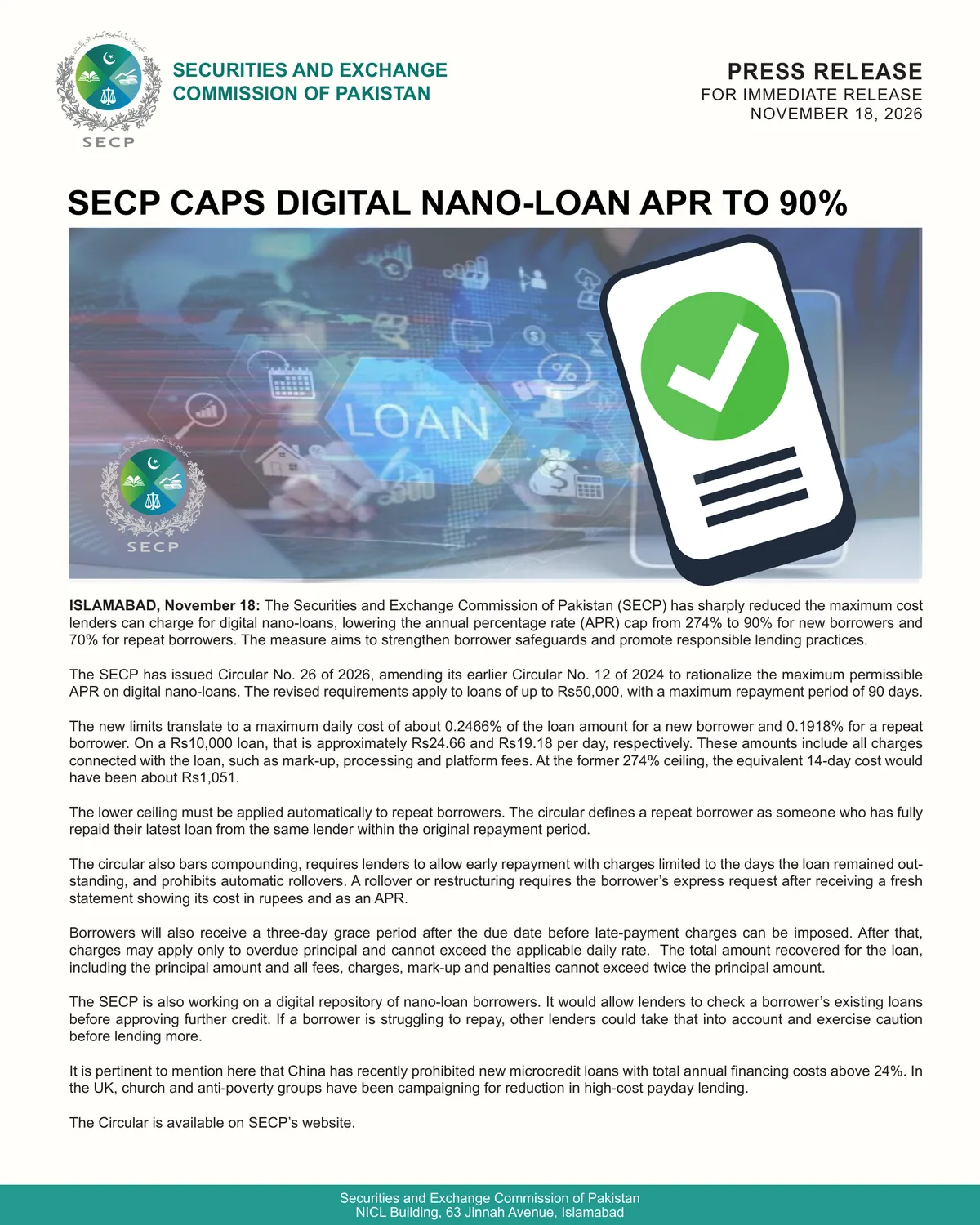
- SECP — Press release: SECP caps digital nano-loan APR to 90%, 18 November 2026 (copy shown above)
- SECP — Circular No. 12 of 2024: Requirements for NBFCs engaged in digital lending, 15 May 2024
Frequently asked questions
What is the maximum APR on digital nano-loans in Pakistan?
Under SECP Circular No. 26 of 2026, in force immediately, 90% a year for new borrowers and 70% for repeat borrowers, down from 274%. The cap covers the total cost of credit, including all mark-up, fees and charges, for nano-loans of up to Rs 50,000 and 90 days.
Who counts as a repeat borrower under SECP Circular 26 of 2026?
A borrower who has already obtained and fully repaid their latest loan from the same digital lender within its original maturity. The lower 70% cap must be applied to them automatically, without any request.
Can a digital lender roll over a nano-loan automatically?
No. A loan may be rolled over, extended or restructured only at the borrower's express request, after a fresh Key Fact Statement shows the cost in rupees and as an APR. The total tenor, including rollovers, cannot exceed 90 days.
When must digital lenders comply with SECP Circular 26 of 2026?
The circular came into force immediately. Within 15 days of issue lenders must update their apps, websites, Key Fact Statements, loan agreements, calculators and risk warnings and notify existing borrowers, and within 30 days they must send SECP a certificate signed by the CEO and Compliance Officer.

This guide is general information based on the law as we understand it on the date shown, not advice for your situation. Tax rules change often — please speak to us before acting on it. See our disclaimer.